
Selected Instructional Design Projects
Designed and Curated by Brian Johnsen
This page highlights selected learning design projects created for high-stakes, compliance-driven environments. Each project demonstrates my approach to performance-based learning, scenario design, and real-world transfer using Articulate Rise 360.
Project Title:
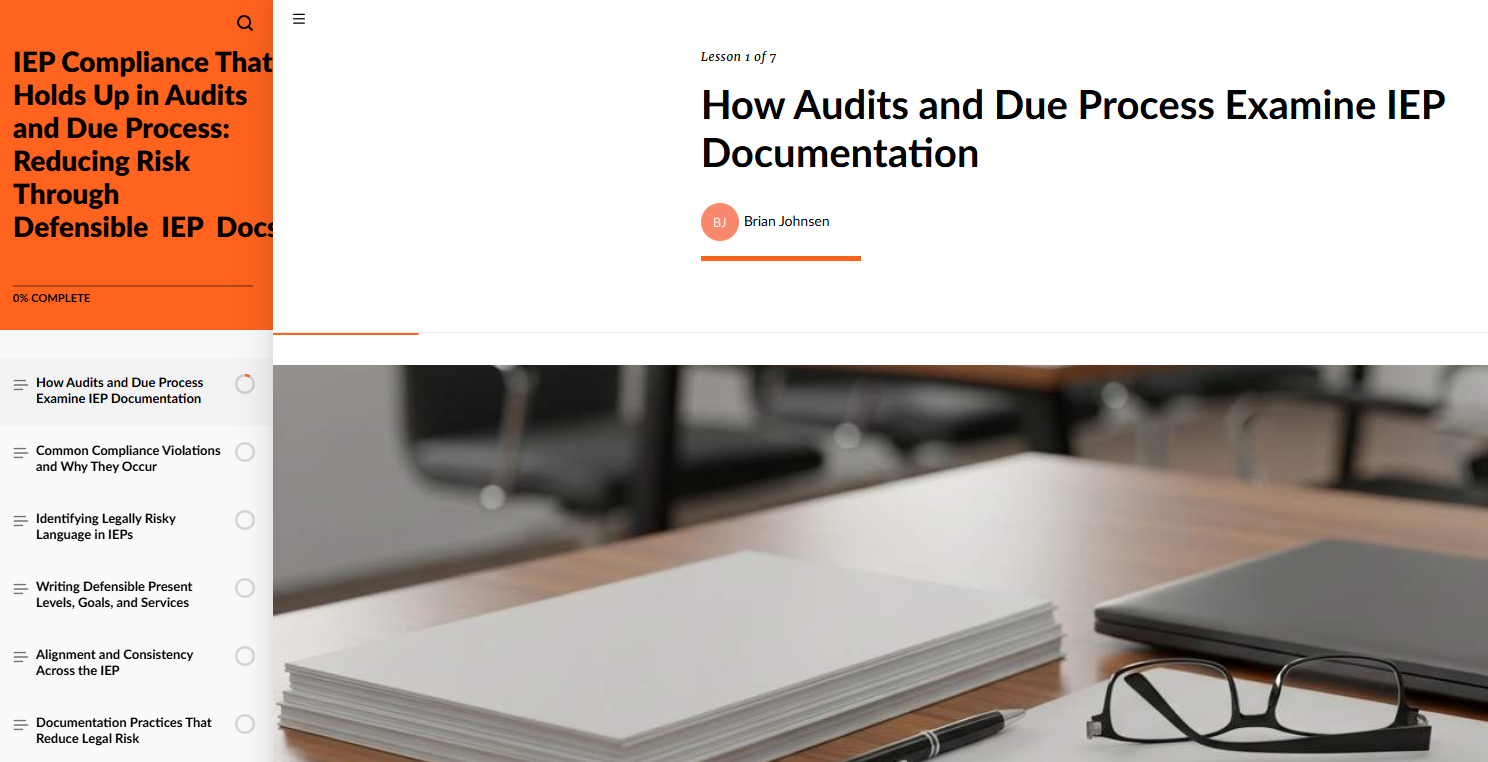
IEP Compliance That Holds Up in Audits and Due Process: Reducing Risk Through Defensible IEP Docs
Role:
Instructional Designer (end-to-end design and development)
Tooling:
Articulate Rise 360
The Problem
Educators operate in a regulated environment where documentation errors can result in audits, complaints, or due process hearings. Existing training focused on policy knowledge, but did not change documentation behavior or decision-making in practice.
Audience:
Special Education Teachers
Case Managers
Site Administrators
Constraints:
High-stakes compliance context
Limited learner time
Wide experience range
Emotional sensitivity
No legal advice permitted
Design Approach:
I designed this course around scenario-based decision-making, focusing on how documentation is evaluated during audits and hearings. Rather than teaching regulations in isolation, learners practice identifying and revising high-risk language using:
realistic examples
scenario-based comparisons
performance-aligned knowledge checks
cognitive load management
Use of Articulate Rise:
I used Articulate Rise 360 to support modular, self-paced learning with embedded scenarios, vocabulary, and comparison blocks. Rise’s structure allowed me to prioritize clarity, accessibility, and rapid iteration while maintaining consistent design across modules.
Outcome/Impact:
Improved confidence in documentation decisions
Greater consistency in written IEP language
Reduced administrative revision cycles
Clearer alignment between instructional intent and documentation
Artifacts:
Online Professional Development Course
Project Title:
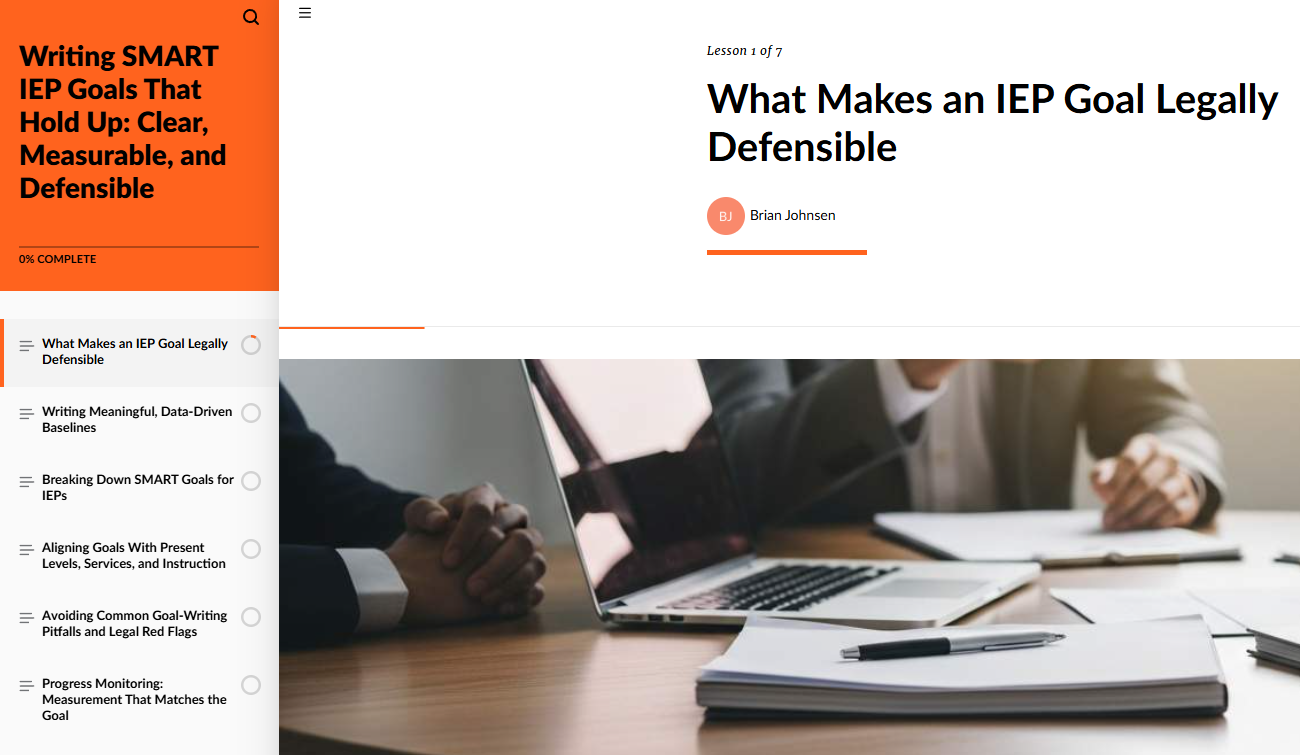
Writing S.M.A.R.T. IEP Goals That Hold Up: Clear, Measurable, Defensible
Role:
Instructional Designer (end-to-end design and development)
Tooling:
Articulate Rise 360
The Problem
IEP goals are frequently written in ways that appear compliant on the surface but lack clarity, measurability, or defensibility. This creates challenges for instruction, progress monitoring, and legal review, and contributes to misalignment across IEP components.
Educators need support translating abstract “S.M.A.R.T.” criteria into practical, defensible goal language.
Audience:
Special Education Teachers
Case Managers
Instructional Leaders Supporting IEP Quality
Constraints:
Learners often reuse existing goal templates
Varying levels of data literacy
Pressure to write goals quickly
Need for examples across academic, functional, and behavior domains
Design Approach:
This course was designed to strengthen decision-making around goal construction, not just knowledge of the S.M.A.R.T. acronym.
Design elements included:
Deconstruction of weak vs. strong goal examples
Explicit alignment between baseline data, goal criteria, and progress monitoring
Guided practice revising real-world goal language
Application prompts encouraging immediate transfer to current caseloads
Use of Articulate Rise:
Rise enabled structured progression from concept to application, with interactive checks and comparison blocks supporting pattern recognition.
Outcome/Impact:
More precise and measurable goal writing
Stronger alignment between goals and instructional plans
Increased confidence during IEP reviews and meetings
Artifacts:
Online Professional Development Course
Project Title:
Present Levels That Tell a Defensible Story: Data-Drive, Individualized, and Aligned
Role:
Instructional Designer (end-to-end design and development)
Tooling:
Articulate Rise 360
The Problem
Present Levels of Academic Performance often contain large amounts of information without a clear narrative or instructional purpose. When data is poorly synthesized, it weakens goal alignment, instructional planning, and legal defensibility.
Educators need support organizing data into a coherent, individualized story that meaningfully informs decision-making.
Audience:
Special Education Teachers
Case Managers
Related Service Providers (Speech and Language Pathologists, Occupational Therapists, etc.)
Constraints:
Multiple data sources with incoherent quality
Pressure to include “everything”
Limited guidance on synthesis vs. reporting
Need to balance instructional clarity with compliance
Design Approach:
This course focused on data interpretation and synthesis, helping learners move from raw information to meaningful documentation.
Key strategies included:
Modeling how to prioritize relevant data
Demonstrating alignment between present levels and goals
Scaffolding narrative construction using clear organization frameworks
Providing examples across academic, functional, and adaptive domains
Learners practiced evaluating whether documentation told a clear, defensible story rather simply listing data points.
Use of Articulate Rise:
Rise supported clear content chunking and progressive disclosure, allowing learners to focus on synthesis without cognitive overload. Examples and reflection prompts were embedded to reinforce judgment and transfer.
Outcome/Impact:
Clearer, more individualized present levels
Stronger alignment across IEP components
Improved instructional clarity and defensibility

Artifacts:
Online Professional Development Course
Meet the Designer

Brian Johnsen, M.S.
My name is Brian Johnsen, and I’m an instructional designer with a background in special education and compliance-driven professional learning. I hold a Master’s degree in Special Education and have extensive experience developing and implementing IEPs, instructional plans, and documentation in highly regulated educational settings. I design learning experiences using performance-based, scenario-driven methods that emphasize real-world transfer, clarity, and defensible decision-making. My strengths include translating complex requirements into practical learning, aligning objectives to authentic tasks, and building systems that support consistent, confident practice.
Portfolio Note
These projects are part of a broader instructional system focused on defensible documentation, performance alignment, and real-world transfer in heavily regulated and complex special education environments.